高校生向けの探究型サイエンスページ Inquiry-based science page for high school students

奥行きがわかる3D天然雪結晶 3D natural snow crystals that reveal depth

このページの主役は、1枚の平面写真では見えない 雪結晶の奥行きです。組み合わせ六花、2重の六花、12花、5花、7花、8花などを、課題の設定 → 情報の収集 → 仮説の構築 → 観測による検証 → データの解釈という現在の高校理科の探究の流れで、論理的かつ見やすく整理しました。  

牟田淳(作成日2026年3月13日,最終更新日:

The main focus of this page is the depth of snow crystals that cannot be seen in a single flat photograph. Combined six-branched crystals, double six-branched crystals, twelve-branched crystals, and five-, seven-, and eight-branched crystals are organized in a clear, logical way through the current high-school science inquiry sequence: setting the question -> gathering information -> building a hypothesis -> testing by observation -> interpreting the data.

Draft page. Created on March 13, 2026; last updated on March 13, 2026.

組み合わせ六花、2重の六花などをもとにしたテーマ Theme based on the Physics Education paper 雪結晶板の厚さ方向の形態がわかる動画教材, 物理教育vol.74.1,8-11,(2026):5月頃リンク予定 Video Teaching Materials Revealing the Thickness-Direction Morphology of Snow Crystal Plates, Physics Education, vol. 74, no. 1, pp. 8–11 (2026): link planned around May
5花、7花などをもとにしたテーマ Theme based on the Tokyo Polytechnic University bulletin paper 北海道で観測された未分類雪結晶の形態多様性, 芸術世界,vol.32,69-77 (2026) New! Morphological Diversity of Unclassified Snow Crystals Observed in Hokkaido, Geijutsu Sekai (2026): link planned around May
動画が最大のセールスポイント The strongest selling point is the videos 全画面表示と一時停止で、前後に重なる結晶板の枚数や位置関係が直感的にわかります。 Full-screen playback and pausing at the right moment make layered crystal plates and their depth relationships easy to grasp.
研究結果を反映 Based on research findings 5花、7花、8花、3角の6花など、未分類雪結晶の解釈を高校生向けに整理しました。 New interpretations of five-, seven-, eight-, and triangular six-branched crystals are summarized for high school readers.
見やすい導線 Easy-to-follow navigation 見にくかった画像リンクをカード型に変更し、画像と詳細ページへ迷わず移動できます。 Hard-to-see image links were rebuilt as clear cards, so visitors can reach images and detailed pages quickly.
Natural snow crystal with layered depth / 複数層の奥行きを感じられる天然雪結晶
冒頭写真: 添付写真を埋め込んだ天然雪結晶の例。中央の結晶と背後の像の重なりが、平面写真だけでは見えにくい立体感を想像させます。 Opening image: an example of a natural snow crystal taken from the attached photograph. The overlap between the crystal in the center and the image behind it suggests a three-dimensional depth that is hard to grasp from a flat photograph alone.
まずは全体像 First, the overall picture

このページの見方 How to use this page

最初に探究の流れを追い、そのあとで画像カードから詳細ページへ移動すると理解しやすくなります。 Start with the inquiry flow, then use the image cards to move to the detailed pages for videos and closer inspection.

6花 Six-branched crystal

中心から6本の枝が伸びる、もっともよく知られた雪結晶の形です。 The best-known snow-crystal form, with six branches extending from the center.

c軸 c-axis

雪結晶板に垂直な厚さ方向です。このページでは、この方向の奥行き理解が中心です。 The thickness direction perpendicular to a crystal plate. This page focuses on understanding that depth.

自動フォーカスブラケット Autofocus bracketing

ピント位置を少しずつ変えながら連続撮影する機能です。断面写真を重ねて動画化できます。 A function that takes a continuous series of images while shifting the focus position little by little. It can be used to turn section-like images into a video.

高校理科の探究の流れで読む Read it through the high-school science inquiry sequence

課題の設定からデータの解釈まで From setting the question to interpreting the data

この構成は、「雪結晶板の厚さ方向の形態がわかる動画教材」,物理教育vol.4.1,(2026)と「北海道で観測された未分類雪結晶の形態多様性」,芸術世界,(2026)の内容を、高校生が追いやすい順番に再編成したものです。 This structure reorganizes the content of “Video Teaching Materials Revealing the Thickness-Direction Morphology of Snow Crystal Plates” (Physics Education, 2026) and “Morphological Diversity of Unclassified Snow Crystals Observed in Hokkaido” (Geijutsu Sekai, 2026) into an order that is easier for high school students to follow.

STEP 1

課題の設定: 雪の結晶は本当に平らなのか Setting the question: Are snow crystals really flat?

教科書や資料集で目にする雪の結晶は、ほとんどが一方向から撮影された平面写真です。しかし、天然雪には、枝が12本に見える12花や、複数の結晶板が重なって1つの6花のように見える組み合わせ六花が存在します。つまり、見た目が6本枝でも、実際には1枚の板とは限りません。

Most snow-crystal images in textbooks and reference books are flat photographs taken from a single direction. But natural snow also includes twelve-branched crystals, in which twelve branches are visible, and combined six-branched crystals, in which multiple crystal plates overlap and look like a single six-branched form. In other words, even when a crystal appears to have six branches, it is not necessarily a single plate.

そこで最初の問いは、「写真だけでは見えない厚さ方向の構造を、どうすれば高校生にもわかりやすく示せるか」です。ここで重要になるのが、結晶板に垂直な方向、すなわち c軸方向の観察です。

So the first question is: how can we show, in a way that is easy for high school students to understand, the thicknesswise structure that cannot be seen in a photograph alone? The key is to observe the direction perpendicular to the crystal plate—that is, the c-axis direction.

探究の焦点: 「美しい形を見ること」から一歩進んで、「どの層にどの枝があるのか」を考えるのがこの研究の出発点です。 Focus of the inquiry: the starting point of this research is to move beyond simply admiring beauty and ask which branches belong to which layer.
STEP 2

情報の収集: 雪の結晶ができるしくみ Gathering information: how snow crystals form

雪結晶は、空気中の水蒸気が氷として成長してできる結晶です。氷の結晶では水分子が六角形の規則的な並びをつくりやすく、そのため雪結晶には近似的な6回対称性が現れやすくなります。まず小さな六角形の角板状結晶ができ、そこから6つの角に沿って枝がのびることで、私たちがよく知る6花が形成されます。

A snow crystal is a crystal formed when water vapor in the air grows as ice. In ice crystals, water molecules tend to form a regular hexagonal arrangement, so snow crystals often show approximate sixfold symmetry. First a small hexagonal plate-like crystal forms, and then branches grow from its six corners to create the familiar six-branched crystal.

ただし、雪の結晶の形は、決して1種類ではありません。結晶が成長する上空の気温や水蒸気量の違いによって、板状、柱状、樹枝状など、さまざまな形に変化します。この気象条件によってどのような雪の結晶ができるかを示した図が「小林ダイヤグラム」です。

However, snow crystals do not have only one form. Differences in temperature and the amount of water vapor in the upper air where the crystals grow produce a wide variety of shapes, including plates, columns, and dendrites. The diagram that shows what kinds of snow crystals form under different meteorological conditions is called the Kobayashi diagram.

なぜ六角形なのか Why hexagons appear

氷の分子配列が六角形の規則を生み、その規則が結晶の外側の形に現れます。 The molecular arrangement of ice favors a hexagonal pattern, and that pattern appears in the external form of the crystal.

なぜ形が変わるのか Why the shape changes

雪結晶の成長は温度と水蒸気量に強く依存するため、空の条件が違うと形も変わります。 Snow crystal growth depends strongly on temperature and water vapor, so different atmospheric conditions produce different shapes.

なぜ奥行きも学ぶのか Why depth also matters

雪結晶はすべて立体です。見える枝の数だけでなく、板が何枚あるか、どの方向に重なるかも重要です。 All snow crystals are three-dimensional. What matters is not only how many branches are visible, but also how many crystal plates there are and how they overlap.

画像リンク 1: 基本の6花と多層結晶の代表画像 Image link 1: representative image of an ordinary six-branched crystal and multilayer crystals

雪結晶の多様性を最初に見るなら、この代表画像が便利です。 This representative image is a convenient first look at the diversity of snow crystals.

代表画像を開く Open the representative image

画像リンク 2: 組み合わせ六花の模式図 Image link 2: schematic of a combined six-branched crystal

どの枝どうしが組み合わさるかを図でつかみたいときに役立ちます。 Useful when you want to grasp, in diagram form, which branches combine with which.

模式図を開く Open the schematic

詳細ページへの入口 Gateway to the detail pages

動画とあわせて学ぶなら、まず雪の結晶トップの詳細ページへ進んでください。 If you want to learn with the videos, start from the main detail page in the snow-crystal section.

詳細ページへ Go to the detail page
STEP 3

仮説の構築: ピントをずらした動画なら奥行きが見えるのではないか Building a hypothesis: A video made by shifting the focus should reveal depth

ここで立てた仮説は明快です。もし雪結晶を上から下へ、少しずつピントをずらしながら連続撮影し、その画像を順番に再生すれば、まるでCTスキャンのように、どの層にどの枝があるかを追跡できるはずです。

The hypothesis proposed here is straightforward. If a snow crystal is photographed continuously while the focus is shifted little by little from top to bottom, and those images are played back in order, then it should be possible to trace which branches belong to which layer, almost like a CT scan.

もともと自動フォーカスブラケット機能は、全体にピントが合った深度合成写真をつくるために使われることが多い機能です。しかしこの研究では、あえて断面写真の連続として利用し、奥行き構造を理解するための教材へ転用しました。ここがこの教材開発の独創性の一つです。

Autofocus bracketing is usually used to make focus-stacked photographs in which the whole subject appears sharp. In this research, however, it was deliberately used as a sequence of section-like images and repurposed into teaching material for understanding depth. This is one of the original ideas behind the development of the material.

仮説のポイント: 写真を「完成品」として見るのではなく、前後方向の情報を持つ連続データとして読むことです。 Key point of the hypothesis: instead of treating the photographs as finished images, read them as sequential data containing front-to-back information.
STEP 4

観測による検証: 動画で解き明かす立体結晶 Testing by observation: three-dimensional crystals revealed by video

北海道の旭岳周辺で行われた観測では、雪結晶を多数の断面写真として記録し、それらをつないだ動画教材が作成されました。すると、平面写真では気づきにくかった複数層構造が、動画では連続的に見えるようになりました。これが本研究の最大の魅力です。

In observations carried out around Mt. Asahidake in Hokkaido, many section-like images of snow crystals were recorded and assembled into video teaching materials. As a result, multilayer structures that are hard to notice in a flat photograph became visible as a continuous sequence in the videos. This is the strongest appeal of the study.

最大のセールスポイント: 動画を全画面表示すると、結晶板が何枚あるかがわかる Strongest selling point: full-screen video shows how many crystal plates there are

各詳細ページでは、動画を全画面表示し、ピントが変わるところで一時停止してみてください。手前、中間、奥という順に層が現れ、枝が重なる関係と重ならない関係の両方を読み取れます。奥行きがわかること自体が、この教材の大きな価値です。 On each detail page, try playing the video full-screen and pausing it where the focus changes. Layers appear in the order front, middle, and back, and you can read both overlapping and non-overlapping branch relationships. The fact that depth itself becomes visible is one of the major values of this material.

1 全画面表示 View full screen
細かな枝先や中心部の変化を見やすくします。 This makes fine branch tips and changes near the center easier to see.
2 連続再生 Play continuously
手前から奥へピントが移る流れを追います。 Follow the way the focus moves from the front toward the back.
3 一時停止して確認 Pause and check
どの層にどの枝が属するかを見分けます。 Work out which branches belong to which layer.

組み合わせ六花 Combined six-branched crystal

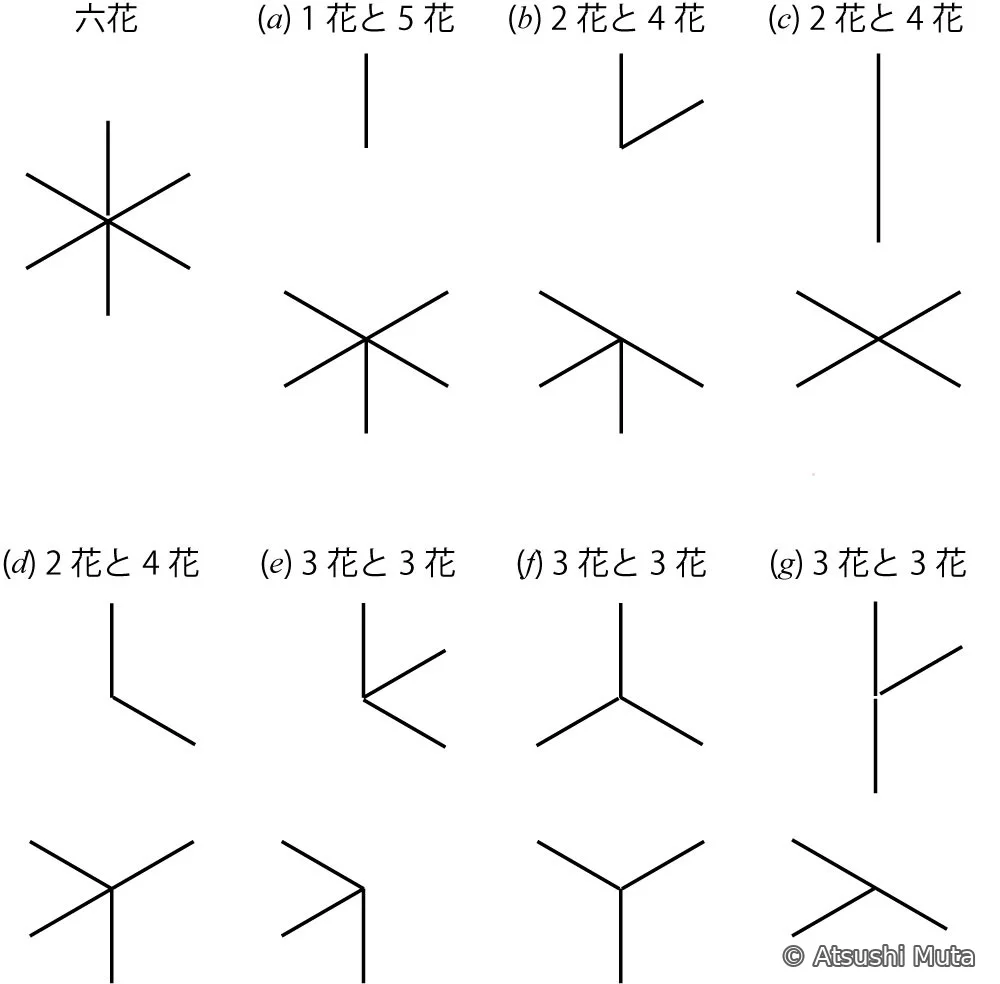
6本未満の枝を持つ複数の雪結晶板が c軸方向に重なり、結果として1つの6花のように見える結晶です。2本枝と4本枝、または3本枝と3本枝の組み合わせなどが知られています。多くの場合、主な枝は互いを避けるように配置されます。 This is a crystal that looks like a single six-branched form even though it is made of multiple crystal plates, each with fewer than six branches, stacked along the c-axis. Known examples include 2+4 and 3+3 combinations. In many cases, the main branches are arranged so that they avoid one another.

組み合わせ六花の詳細へ See details of combined six-branched crystals

2重の六花 Double six-branched crystal

手前の層の枝が、奥の層の枝と c軸方向に重なっているタイプです。横から見れば2枚の皿が重なっているような構造で、動画にすると枝どうしの対応関係が読み取りやすくなります。 This type has branches in the front layer overlapping branches in the back layer along the c-axis. Seen from the side, the structure is like two plates stacked one behind the other, and the video makes the branch-to-branch correspondence much easier to follow.

2重の六花の詳細へ See details of double six-branched crystals

12花と3層結晶 Twelve-branched crystals and three-layer crystals

層が3枚以上になると、12本枝に見える大きな結晶や、手前と奥では枝が重なるのに中間層だけ位置がずれる複雑な結晶も現れます。ここでは奥行きの理解が形の理解に直結します。 When there are three or more layers, large crystals that appear to have twelve branches can occur, as can complex crystals in which the front and back branches overlap while only the middle layer is displaced. Here, understanding depth directly leads to understanding shape.

12花と3層結晶の詳細へ See details of twelve-branched and three-layer crystals
STEP 5

データの解釈: 未分類結晶の見え方が変わった Interpreting the data: unclassified crystals look different once depth is taken into account

工芸大紀要論文では、北海道で観測された未分類雪結晶として、5花、7花、8花、3角の6花などが詳しく検討されています。重要なのは、「枝の数が変わって見える理由」が1つではないことです。動画やピント位置の解析によって、重なりによるものと、角の変形や裂開によるものを区別できるようになりました。

The Tokyo Polytechnic University bulletin paper closely examines unclassified snow crystals observed in Hokkaido, including five-, seven-, eight-, and triangular six-branched forms. The important point is that there is not just one reason why the visible number of branches changes. Analysis using videos and focus positions has made it possible to distinguish cases caused by overlap from cases caused by corner deformation or splitting.

形態 Morphology 観測と解釈 Observation and interpretation 高校生が注目したい点 What students should notice
5花 5花には、1枚の結晶板からできた例と、2枚以上の結晶板が重なった「組み合わせ5花」の両方が見つかりました。つまり「6花の枝が1本欠けた」とだけ考えるのでは不十分です。 Among five-branched crystals, some examples are made from a single plate, while others are combination five-branched crystals formed by overlapping two or more plates. So it is not enough to say that a five-branched form is simply a six-branched crystal missing one branch. 同じ5花でも形成過程が複数ある点が重要です。動画は、その見分けに役立ちます。 The key point is that even the same five-branched appearance can come from more than one formation process. The video helps distinguish them.
7花 7花にも複数のタイプがあります。中心角板の角が変形して枝が2本出た例と、1花と6花が重なった「組み合わせ7花」の例が確認されました。 Seven-branched crystals also show more than one type. Some examples result from deformation of a corner in the central plate, while others are combination seven-branched crystals made by overlap of a one-branched and a six-branched plate. 枝の本数だけで分類すると、本当の形成過程を見落とすことがあります。 If we classify crystals only by branch count, we may miss their real formation processes.
8花 今回の観測例の8花は、上下方向の角が裂開して、それぞれ2本ずつ枝が出たと解釈されました。つまり、この例では重なりよりも角の裂開が重要です。 In the observed eight-branched example, the interpretation is that the upper and lower corners split, producing two branches each. In this case, angle splitting is more important than overlap. 動画解析の価値は、「何でも重なりと決めつける」のではなく、重なり型と裂開型を区別できる点にあります。 The value of video analysis is not that it makes everything an overlap-type crystal, but that it allows us to distinguish overlap-type structures from splitting-type structures.
3角の6花 一見すると「長さの違う2つの3花」が重なったように見えますが、観測では、1花と5花の重なり、あるいは3枚の結晶板の重なりで説明できる例が示されました。 At first glance, triangular six-branched crystals can look like two three-branched crystals of different sizes. But observations showed examples that are better explained as an overlap of a one-branched and a five-branched plate, or even as an overlap of three plates. 見た目の印象だけでは不十分で、奥行きの情報が解釈を変えることがわかります。 Appearance alone is not enough; depth information changes the interpretation.
ここが大事: 5花では重なり型が確認され、3角の6花でも重なりが重要でした。一方で、8花の観測例は重なりではなく裂開型でした。つまり、奥行きを見ることは、結晶を正しく分類し直すための科学的手がかりになります。 This is the key point: overlap was confirmed in five-branched crystals, and overlap was also important in triangular six-branched crystals. By contrast, the observed eight-branched example was not an overlap type but a splitting type. In other words, seeing depth becomes scientific evidence for correctly reinterpreting and reclassifying crystals.
授業でどう使えるか How this can be used in class

高校理科に向いた教材としての価値 Value as a teaching material for high-school science

大学での教育実践では、動画を見た後に複数層構造を正しく解釈した学生が多数を占めました。高校でも、気象、結晶、観察法、データ解釈をつなぐ教材として使えます。 In university teaching practice, many students correctly interpreted the multilayer structure after watching the videos. In high school as well, this can be used as a teaching material that connects weather, crystals, observation methods, and data interpretation.

物理教育論文では、動画教材を見た後に「六本枝の天然雪結晶の中には、手前と奥に枝が分かれる複数層構造のものがある」と正しく答えた学生が多数でした。これは、写真だけでは難しい c軸方向の理解に、動画が有効であることを示しています。

In the Physics Education paper, many students correctly answered that among natural six-branched crystals, some have multilayer structures in which the branches are divided into front and back layers. This shows that video is effective for understanding the c-axis direction, which is difficult to grasp from photographs alone.

397 回答者 respondents
375 正答 correct

授業の導入 Lesson introduction

まず1枚の写真だけを見せ、「この結晶は1枚か、複数枚か」を予想させると、課題意識が高まります。 Start by showing a single photo and asking whether the crystal is one plate or several. This raises curiosity immediately.

観察の場面 Observation phase

動画を再生し、ピントが合う層で止めながら、どの枝がどの層に属するかを班ごとに整理させます。 Play the video and pause when a layer comes into focus, then let students organize which branches belong to which layer.

解釈の場面 Interpretation phase

5花、7花、8花を比べると、「同じ本数の違いでも形成過程は同じではない」と学べます。 Comparing five-, seven-, and eight-branched crystals shows that the same branch-count difference does not imply the same formation process.

検索にも強い要約型Q&A Search-friendly summary Q&A

よくある質問 Frequently Asked Questions

雪結晶の基礎と今回の研究のポイントを、短い問いと答えで確認できます。 These short questions and answers let you review both the basics of snow crystals and the key points of this research.

なぜ雪の結晶は6本の枝を持つことが多いのですか。 Why do snow crystals often have six branches?

氷の分子配列が六角形の規則を生み、6つの角から枝が成長しやすいからです。その結果、近似的な6回対称性が現れます。

Because the molecular arrangement in ice favors a hexagonal pattern, branches tend to grow from six corners, producing approximate sixfold symmetry.

c軸とは何ですか。 What is the c-axis?

雪結晶板に垂直な厚さ方向のことです。このページでは、平面写真では見えにくいその奥行きを動画で理解できるようにしています。

It is the thickness direction perpendicular to a snow-crystal plate. This page uses videos to make that depth easier to understand.

なぜ1枚の写真より動画の方がわかりやすいのですか。 Why is a video easier to understand than a single photo?

ピントが手前から奥へ動くことで、どの層にどの枝があるかを時間の流れで追えるからです。複数層構造を直感的に理解しやすくなります。

Because as the focus moves from front to back, you can follow over time which branches belong to which layer. That makes multilayer structure much easier to grasp intuitively.

5花や8花は単純に「変わった6花」なのですか。 Are five- and eight-branched crystals simply unusual six-branched crystals?

単純ではありません。5花には重なり型もあり、7花には重なり型と角の変形型があります。今回の観測例の8花は、角の裂開による形成と解釈されています。

No. Five-branched crystals can include overlap types, and seven-branched crystals include both overlap types and corner-deformation types. In the observed eight-branched example discussed here, the interpretation is formation by corner splitting.

このページの根拠 What this page is based on

もとにした2つの資料 The two source papers

このWebページは、以下の2つの論文の内容を高校生向けに再構成したものです。 This web page reorganizes the content of the following two papers for high school readers.

物理教育vol74.1,8-11(2026): 雪結晶板の厚さ方向の形態がわかる動画教材の開発 Physics Education, vol. 74, no. 1, pp. 8–11 (2026): Development of Video Teaching Materials Showing the Thickness-Direction Morphology of Snow Crystal Plates

c軸方向の見せ方、組み合わせ六花、2重の六花、3層結晶、そして授業実践の結果が書かれた論文です。 This paper discusses how to present the c-axis direction, combined six-branched crystals, double six-branched crystals, three-layer crystals, and the results of classroom practice.

東京工芸大学芸術学部, vol32,69-77 (2026): 北海道において観測された未分類の雪結晶 - 5花、7花等の形態多様性 Tokyo Polytechnic University bulletin paper, in press (2026): Unclassified Snow Crystals Observed in Hokkaido — Morphological Diversity of Five-, Seven-, and Related Forms

5花、7花、8花、3角の6花などについて、重なり型と裂開型の違いを含む新しい形態解釈を与えています。 This paper presents new morphological interpretations of five-, seven-, eight-, and triangular six-branched crystals, including the distinction between overlap types and splitting types.