Interactive 3D models of combined and stacked snow crystals
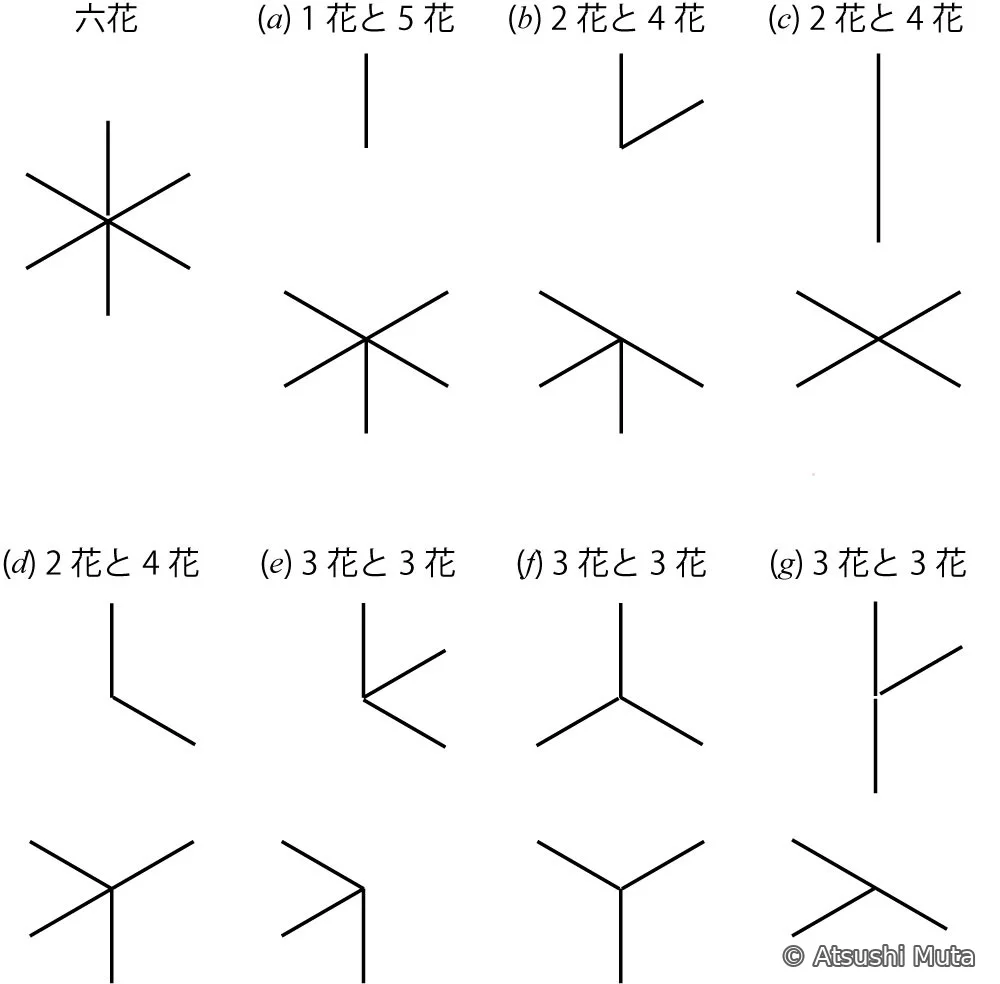
Some crystals that look like an ordinary six-branched snow crystal from above are actually composed of multiple plates. This page distinguishes combined six-branched crystals, whose incomplete branch sets complement one another, from stacked crystals, whose plates overlap along the c-axis.
Drag a model to rotate it. Use Top, Oblique and Side views, then move the Separate slider to reveal individual plates.
1. 1+5 combined six-branched crystal
A one-branched plate and a five-branched plate share a centre and together appear as a six-branched crystal. From the side, the two plates occupy slightly different depths.
MP4 version: 1+5 combined crystal
View a static fallback image

2. 2+4 combined crystal
A two-branched plate and a four-branched plate can complement one another in three layouts, depending on whether the two branches are separated by 60°, 120° or 180°.
MP4 versions: 60° / 120° / 180°
View a static fallback image

3. 3+3 combined crystal
Two three-branched plates can form adjacent, 2+1, or alternating arrangements. In the alternating case, branches switch between the upper and lower plates around the centre.
MP4 versions: adjacent / 2+1 / alternating
View a static fallback image

4. Double plate and twelve-branched form
Two complete six-branched plates overlap along the c-axis. At 0° they can look like one plate; at 30° their branches alternate and the outline appears twelve-branched. An angle alone does not determine the complete formation mechanism.
5. Three-layer specimen reconstructed from focus images
Focus-shift photographs support a lower four-branched plate, a middle two-branched plate and a smaller upper crystal. The model combines a 2+4 structure with an additional stacked plate.
MP4 version: three-layer snow crystal
View a static fallback image

Glossary
- Combined six-branched crystal
- Two plates with fewer than six developed branches share a centre and together form a six-branched outline, such as 1+5, 2+4, or 3+3.
- Stacked snow crystal
- Two or more plate-like crystals overlap at different depths along the c-axis. A focus-shift sequence can bring the layers into focus separately.
- Twelve-branched form
- An outline produced when two six-branched plates overlap with a relative rotation. In the global classification, twelve-branched crystals are P5d; the observed angle alone does not uniquely establish the formation path.